
HPLC Purity Is Not Peptide Content: How to Read a Lyophilized Peptide COA
A 98% HPLC result describes the chromatographic area assigned to the main peptide peak under one method. It does not mean that 98% of the powder mass is peptide.
A 98% HPLC result describes the chromatographic area assigned to the main peptide peak under one method. It does not mean that 98% of the powder mass is peptide.
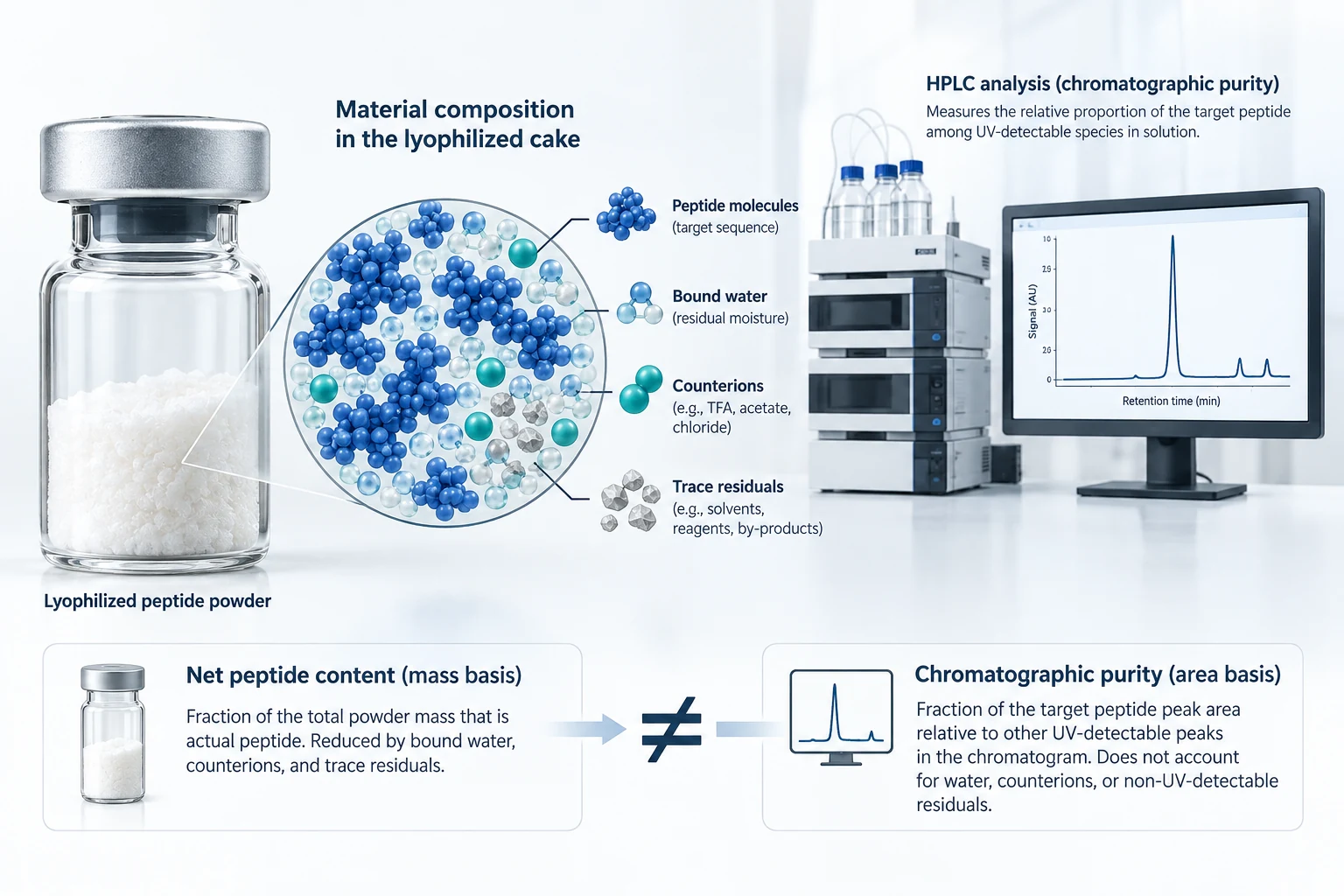
A reported HPLC purity of 98% usually means that the main peptide peak accounts for about 98% of the integrated area detected under a particular chromatographic method. It does not establish that 98% of the lyophilized powder mass is peptide. Water, counterions, residual solvents, salts and components with little or no response at the selected detector wavelength may sit outside that calculation.
Reverse-phase HPLC separates components according to how they interact with the stationary phase and mobile phase. The detector then records a signal, often UV absorbance, as each component leaves the column. Area normalization expresses the main peak area as a share of the total integrated area. The result depends on the method: column chemistry, gradient, temperature, wavelength, integration rules and sample preparation can all affect what separates and what is counted.
A component that absorbs weakly at the chosen wavelength may make a small contribution to peak area while still contributing mass. Water and many inorganic or ionic components are not represented by a standard UV area-purity calculation. Co-eluting peptide-related impurities can also hide beneath a main peak. The EMA synthetic peptide guideline, effective June 2026, therefore treats purity, assay or content, counterion content, residual TFA, water and residual solvents as separate specification considerations.
The visible cake or powder can contain the target peptide plus its associated salt form, retained water and other specified components. The balance depends on sequence, manufacturing route, purification, salt exchange, formulation and drying. A buyer should avoid calculating target-peptide mass from chromatographic purity alone.
| Component or attribute | Question it answers | Typical analytical approach |
|---|---|---|
| Peptide-related purity | How much of the detected chromatographic response belongs to the main peptide peak? | RP-HPLC or UPLC with a defined detector and integration method |
| Identity | Is the principal material the intended peptide? | Mass spectrometry, peptide mapping, amino acid analysis, NMR or another suitable orthogonal method |
| Assay or peptide content | How much peptide is present on the stated mass basis? | LC against a reference standard, amino acid analysis, elemental or nitrogen analysis, or qNMR when justified |
| Water | How much of the sample mass is water? | Karl Fischer titration or another validated method suitable for the matrix |
| Counterion | Which anion balances charged peptide sites, and how much is present? | Ion chromatography, suitable NMR, capillary electrophoresis or another validated approach |
| Residual solvents | What process solvents remain and at what level? | Headspace GC or another product-specific method |
“Peptide content” needs a method and a calculation basis. The value may be reported as supplied, on a dry basis, as free peptide, or relative to a defined reference standard. Those bases are not interchangeable. For example, correcting for water without correcting for counterion mass does not produce the same figure as a direct assay of the peptide.
The 2025 EMA guideline lists LC, amino acid analysis, elemental analysis, Kjeldahl nitrogen analysis and quantitative NMR among possible approaches for assay or content. The choice depends on the molecule, reference material and intended purpose. ICH Q2(R2) frames validation around fitness for intended purpose, with characteristics such as specificity, accuracy, precision and range selected for the measurement being made. A method suitable for relative impurity profiling may need different evidence from a method used to assign a mass fraction.
Consider an illustrative 100 mg sample with 98.0% HPLC area purity and a separately determined peptide content of 76.0% as supplied. The HPLC result indicates that the main peptide peak dominates the detected peptide-related profile under that method. The content result assigns 76 mg of peptide per 100 mg of supplied material on its stated basis. Multiplying 100 mg by 98% would give 98 mg, which would overstate the assigned peptide amount in this example.
This calculation is a teaching example, not a Hytanbio batch result. A real calculation should use the current specification and COA, including the stated basis, method, uncertainty or reporting rules where applicable. A formulator should also confirm whether the requested amount refers to total powder, free peptide, peptide salt or another defined quantity.
For cosmetic formulation, the supplier result remains one input to the finished-product program. Compatibility, preservative strategy, packaging interaction, safety assessment and finished-product stability still need their own evidence. Pharmaceutical-development inquiries require a project-specific quality and regulatory pathway; a public catalog page does not establish that scope.
No. The value normally describes the relative area of detected chromatographic peaks. Water, counterions and other components can contribute mass without appearing in the percentage.
Use the quantitative value and basis agreed in the specification, such as peptide content or assay. Confirm whether it is reported as supplied, on an anhydrous basis or on another defined basis.
A retention time or peak alone is rarely unambiguous. The EMA guideline recommends at least two orthogonal identification methods for synthetic peptide active substances in its scope.
Salt form, water, residual components, method conditions and calculation basis can differ. Compare aligned specifications rather than headline percentages.
The regulatory documents above apply within their stated pharmaceutical scopes. This article uses their analytical distinctions to explain purchasing questions. It does not assign a pharmaceutical grade to a cosmetic or research material.