
Residual Moisture and Glass Transition in Lyophilized Peptide Powder
Freeze-drying removes most water, but the useful target is a product-specific moisture range supported by stability data, not the lowest number a dryer can produce.
Freeze-drying removes most water, but the useful target is a product-specific moisture range supported by stability data, not the lowest number a dryer can produce.
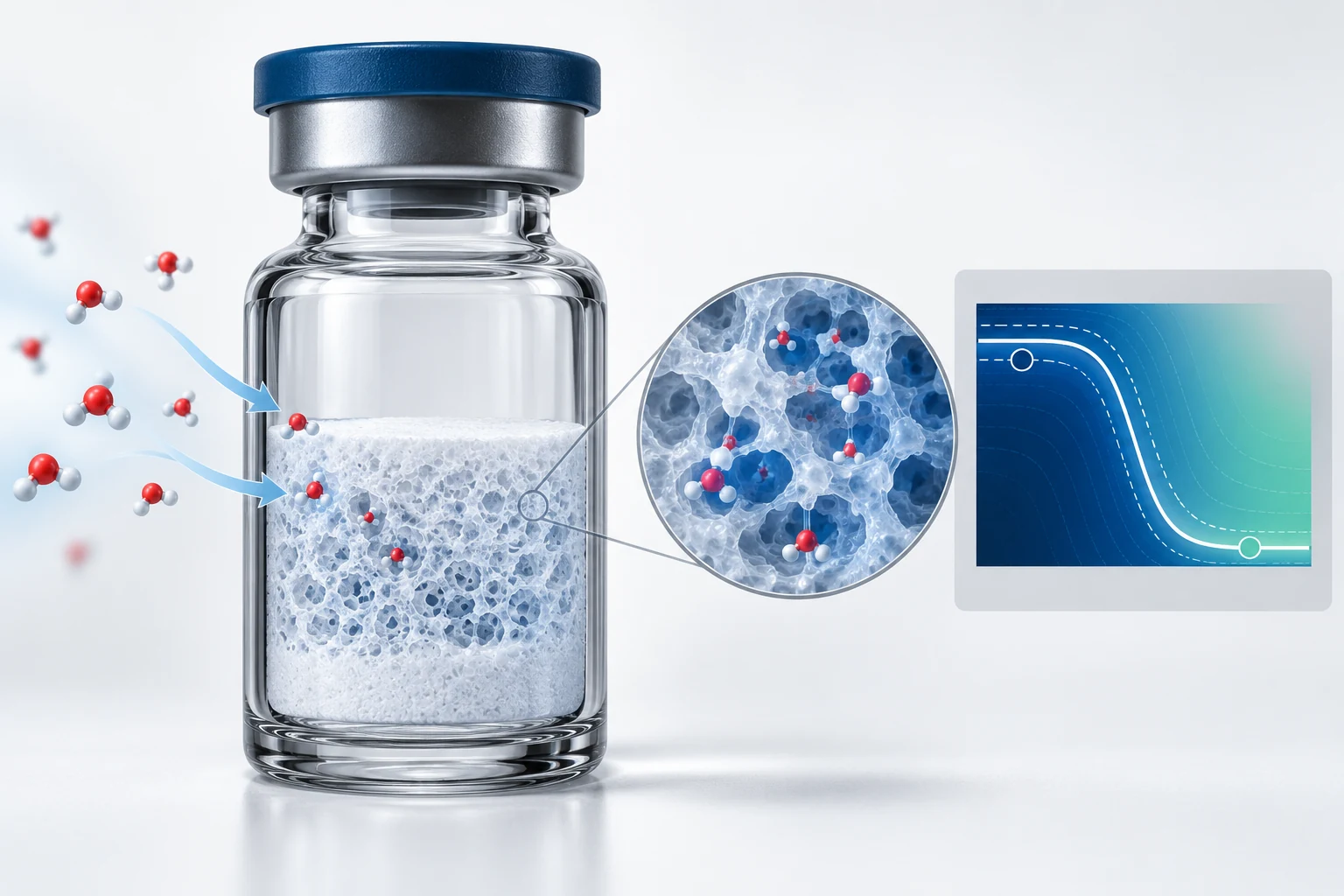
Lyophilization does not create a water-free peptide powder. It creates a dry solid with a residual-moisture level shaped by formulation, freezing, primary drying, secondary drying and the package. The correct target is the moisture range that supports the product’s physical and chemical stability, not the smallest number that an aggressive cycle can produce.
Primary drying removes ice by sublimation. Secondary drying reduces water that remains adsorbed to the dried matrix. Some water stays associated with polar groups in the peptide and excipients, and its removal becomes progressively slower as drying continues. The final value depends on product temperature, chamber pressure, duration, fill depth, vial heat transfer and the way the formulation forms a solid matrix.
A dry-looking cake cannot reveal its water content. Cracks, shrinkage or collapse may signal process or formulation problems, but a visually intact cake can still hold more water than intended. The receiving specification should therefore name a suitable analytical method and sampling plan. Karl Fischer titration is commonly used because it measures water directly; loss on drying can include other volatile material and may be too nonspecific for some products.
Many lyophilized formulations are amorphous solids. Below their glass transition temperature, molecular motion is constrained. Water acts as a plasticizer, so additional moisture can lower the glass transition temperature and increase molecular mobility at a given storage temperature. The classic review by Hageman reported that moisture, temperature and formulation composition work together in determining stability. The same moisture percentage can therefore have different consequences in two formulations.
Developers often examine the relationship between storage temperature and the glass transition of the dried product. A larger margin can reduce mobility-related risk, but glass transition is not a complete stability model. Chemical pathways can proceed below the transition, crystallization may redistribute water, and peptides can respond differently to the same excipient system. Differential scanning calorimetry can characterize thermal transitions, while moisture testing and stability-indicating assays show whether the chosen process and package hold the intended quality profile.
Excess residual water can accelerate degradation by increasing flexibility and reactant mobility. Over-drying can also remove water that helps maintain local structure in some protein and peptide systems. The practical target is usually a justified range with an upper and, when needed, lower boundary. Cycle development should test that range against real stability results rather than relying on a copied limit from another material.
| Question | Evidence to collect | Decision supported |
|---|---|---|
| How much water remains? | Validated or qualified moisture method, sample handling controls and representative vials | Release range and drying endpoint |
| Is the matrix physically stable? | Glass transition, crystallinity and cake-structure observations as relevant | Cycle and storage margin |
| Is the peptide chemically stable? | Stability-indicating purity, assay and product-specific degradation markers | Moisture target and shelf-life proposal |
| Will the package maintain the state? | Container-closure integrity, moisture ingress and transport studies | Vial, stopper, seal and secondary pack |
A vial, stopper and seal form the moisture barrier after drying. Stopper formulation, seating, residual headspace, crimp quality and storage humidity can affect ingress over time. Repeated opening exposes hygroscopic powder to room air and creates a different condition from the unopened package. A bulk pack that is opened many times may need a dispensing plan, smaller pack sizes or controlled-atmosphere handling.
Shipping deserves its own assessment. The long-term storage label does not automatically define allowable transport excursions, and a brief warm shipment is not equivalent to months at that temperature. A route plan should consider duration, season, customs delay, pack-out and available excursion data. At receipt, record the lot, package condition and monitor result before opening the container.
ICH Q1A(R2) gives stability-study principles for new pharmaceutical drug substances and products, including storage conditions and packaging considerations. Cosmetic and research projects are outside that registration scope, but the discipline remains useful: test the actual material in its actual container, use meaningful methods and avoid assigning shelf life from appearance alone.
No. Residual water remains associated with the dried matrix. The acceptable range is product-specific.
No. Excess moisture can increase mobility, while over-drying can damage some systems. Stability data should define the range.
Water can lower the glass transition temperature of an amorphous matrix. A lower transition can reduce the storage-temperature margin and increase molecular mobility.
No. Appearance is a useful physical observation, but it does not quantify water or establish chemical stability.
Much of the established mechanistic literature concerns proteins and pharmaceutical formulations. A short synthetic peptide may behave differently. Material-specific development remains necessary.