
How to Build a Stability-Indicating Method for a Lyophilized Peptide
A stability-indicating method must distinguish the peptide from relevant degradation products and remain fit for its intended decision throughout routine use.
A stability-indicating method must distinguish the peptide from relevant degradation products and remain fit for its intended decision throughout routine use.
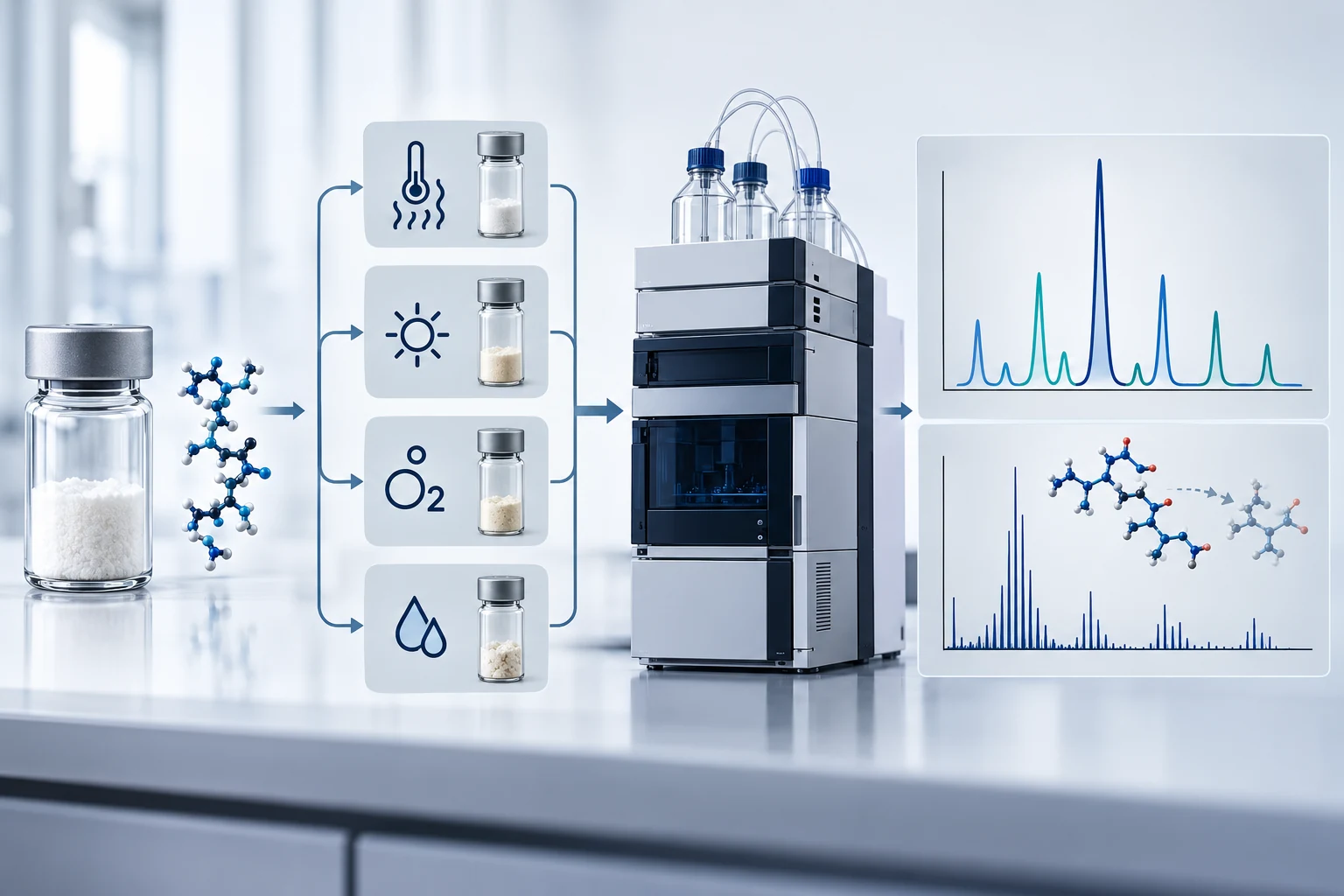
A stability-indicating analytical procedure must measure the intended peptide attribute while distinguishing relevant degradation products, impurities and matrix components. A sharp main HPLC peak is not enough. The method needs an explicit purpose, representative stressed samples, evidence of specificity and controls that keep it performing during routine use.
ICH Q14 introduces the analytical target profile as a statement of what the procedure must measure and the performance it must achieve. For a lyophilized peptide, one method may need to quantify the main peptide and related substances during stability, while another confirms identity or measures water. Combining every question into one chromatogram can create blind spots.
An analytical target profile should name the sample, reportable result, expected range, required selectivity and decision being supported. A cosmetic raw-material monitoring method and a pharmaceutical release or stability method may share technology but carry different validation and regulatory expectations. Define the use before selecting performance characteristics.
Forced degradation creates samples that challenge specificity. Peptides may undergo oxidation, deamidation, hydrolysis, disulfide changes, aggregation, isomerization or cleavage depending on sequence and conditions. Useful stress factors can include heat, light, controlled humidity, acid or base, and oxidant exposure. The design should consider the lyophilized state as well as reconstituted or formulation conditions when those states matter.
Severe exposure can produce a complex mixture with little connection to normal degradation. Weak exposure may show no challenge. Method developers commonly adjust stress level and duration to create measurable change while retaining enough parent peptide to examine separation and mass balance. Controls are needed to distinguish stress effects from solvent, container or sample-preparation artifacts.
ICH Q2(R2) defines specificity and selectivity in terms of interference from impurities, degradation products, matrix components and other substances. Evidence can include peak-resolution data, diode-array or spectral assessment, LC-MS, comparison with blanks and excipients, and analysis of independently prepared stressed samples. Co-elution is a particular concern for closely related peptide impurities.
The EMA synthetic peptide guideline notes the structural complexity of peptide-related impurities and the risk of co-elution. It states that additional independent methods may be needed when one procedure cannot separate all relevant impurities. It also recommends at least two orthogonal identification methods within its active-substance scope. The exact package should follow the peptide and use rather than a fixed checklist.
| Performance characteristic | Question for a peptide stability method |
|---|---|
| Specificity or selectivity | Can the method distinguish the main peptide from relevant degradants, impurities and matrix signals? |
| Accuracy | Does the result agree with an accepted value or recovery model across the intended range? |
| Precision | How much variation comes from repeat preparation, analysts, days, instruments or laboratories? |
| Range and response | Are reportable results supported from expected release values through meaningful stability change? |
| Detection and quantitation limits | Can low-level impurities be detected or measured at the required reporting threshold? |
| Robustness | Do small deliberate changes in flow, temperature, pH, gradient or preparation preserve performance? |
Validation experiments should use representative matrices and sample preparation. A method transferred from a neat peptide standard may respond differently to a formulated cake, a blend or a reconstituted sample. System suitability checks should detect failures that matter for the intended result.
Q14 treats development knowledge, risk assessment and the analytical procedure control strategy as connected. Critical parameters identified during development should become controlled settings or monitored ranges. Trend system-suitability data, retention, resolution and reference-standard behavior so drift is visible before results become unreliable.
A website statement that a product was “tested by HPLC” does not establish a stability-indicating method. Buyers should request the applicable specification, method description or validation summary appropriate to the project.
No. The developer must show that relevant degradants and matrix components do not interfere with the result.
No. The conditions should create informative challenge samples. Exposure is adjusted to the peptide and pathway.
LC-MS adds mass evidence, but it does not automatically resolve co-elution or provide validated quantitation for every component.
Assess it after changes that may affect intended performance. Q2(R2) allows the scope to be partial or full according to the change.