
TFA, Acetate and Chloride: Counterions in Synthetic Peptide Powder
A synthetic peptide powder is commonly supplied as a salt. Counterion identity and amount affect composition, molecular weight interpretation and formulation behavior.
A synthetic peptide powder is commonly supplied as a salt. Counterion identity and amount affect composition, molecular weight interpretation and formulation behavior.
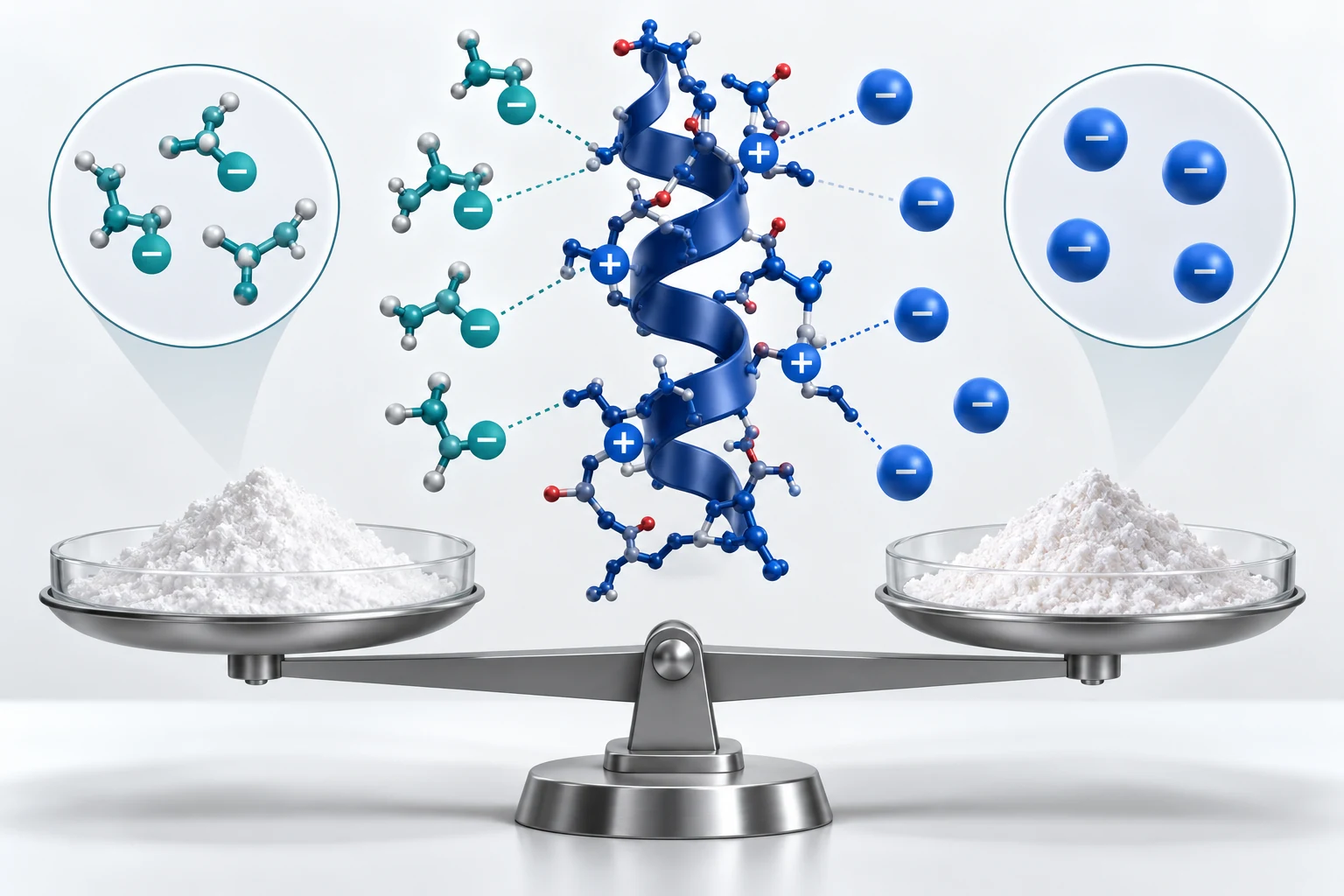
A synthetic peptide with protonated basic groups needs negatively charged counterions. TFA, acetate and chloride are common examples. Their identity and amount affect the mass composition of the dried powder and can influence solubility, conformation, self-association and formulation behavior. The peptide sequence molecular weight alone does not describe the whole salt.
Trifluoroacetic acid is widely used to cleave a protected peptide from solid-phase synthesis resin and remove acid-labile protecting groups. It is also used as an ion-pairing additive in many reversed-phase purification methods. Positively charged sites on the peptide can associate with trifluoroacetate, so the isolated lyophilized material often contains TFA as a counterion.
Calling all TFA an ordinary process impurity can obscure the chemistry. Some of it can be stoichiometrically associated with charged sites, while additional residual acid may also be present. The sequence, number of basic residues, pH history, purification method and isolation process influence the measured amount. A fixed correction factor copied from another peptide is therefore unreliable.
The peptide moiety, counterion and water all contribute to weighed powder. Short, highly basic peptides can carry a meaningful counterion fraction because several charged sites may each associate with an anion. That mass is absent from a molecular weight calculated for the neutral peptide sequence. Formulation calculations should state whether they use powder mass, peptide salt mass, free-peptide equivalent or a separately assigned peptide content.
| Counterion | Why it may be present | Points to confirm |
|---|---|---|
| Trifluoroacetate | Common outcome of TFA cleavage and RP-HPLC purification | Measured amount, residual free TFA, intended-use suitability and method |
| Acetate | Often selected after ion exchange or isolation in acetic-acid conditions | Exchange completeness, acetate content, water and impact on solubility |
| Chloride | May be selected through hydrochloride exchange for a defined project | Chloride content, pH behavior, hygroscopicity and compatibility |
The EMA synthetic peptide guideline states that counterion type can affect biological and physicochemical properties. Within its pharmaceutical scope, it calls for a defined counterion and a justified control of its amount, and it lists residual TFA and water as separate considerations.
Exchange replaces one associated anion with another through repeated dissolution and lyophilization, ion-exchange media, dialysis or another process suited to the peptide. The process must remove the original ion to the agreed level and establish the replacement ion. It can also change recovery, aggregation, solubility or physical form. A label such as “acetate salt” does not prove complete removal of TFA.
A 2025 study by Rupp and colleagues compared TFA detection methods and investigated exchange to chloride for selected peptides. It used validated approaches including ion chromatography, 19F NMR, ATR FT-IR, RP-HPLC-UV and HPLC-ELSD. The study found sequence-dependent counterion amounts and showed why both the departing and replacement ions matter. Its results describe the peptides and conditions studied; they are not a universal exchange recipe.
Method choice depends on the ion, expected level, matrix and required accuracy. Ion chromatography can separate and quantify ionic species. 19F NMR is useful for fluorinated TFA. Quantitative NMR or other suitable techniques may assign acetate, while capillary electrophoresis and spectroscopic methods can support specific applications. A method needs adequate specificity and calibration for the intended measurement.
A clean peptide HPLC chromatogram does not assign counterion content. Conversely, a counterion result does not establish sequence identity or peptide-related purity. A complete specification may need peptide identity, related-substance purity, assay or content, counterion identity and amount, water and residual solvents. The combination depends on intended use and risk.
Counterion choice must follow the project. Cosmetic, research and pharmaceutical-development materials have different evidence and regulatory needs. A salt exchange alone does not make a material sterile, injectable or approved for human use.
TFA is commonly used in cleavage and reversed-phase purification. Trifluoroacetate can remain associated with protonated peptide sites after isolation.
No. The choice depends on sequence, use, formulation and evidence. Exchange can affect recovery and behavior, so it should be qualified.
It may change the salt composition without materially changing the peptide-related area purity. Test both attributes with suitable methods.
The supplier should state the basis. Sequence molecular weight often describes the peptide moiety, while the supplied powder can include variable counterion and water.