
Excipient Selection for Lyophilized Peptide Powder: Sucrose, Trehalose and Mannitol
A molecule-specific framework for comparing sugars, mannitol and buffer systems in cosmetic lyophilized peptide vial development.
A molecule-specific framework for comparing sugars, mannitol and buffer systems in cosmetic lyophilized peptide vial development.
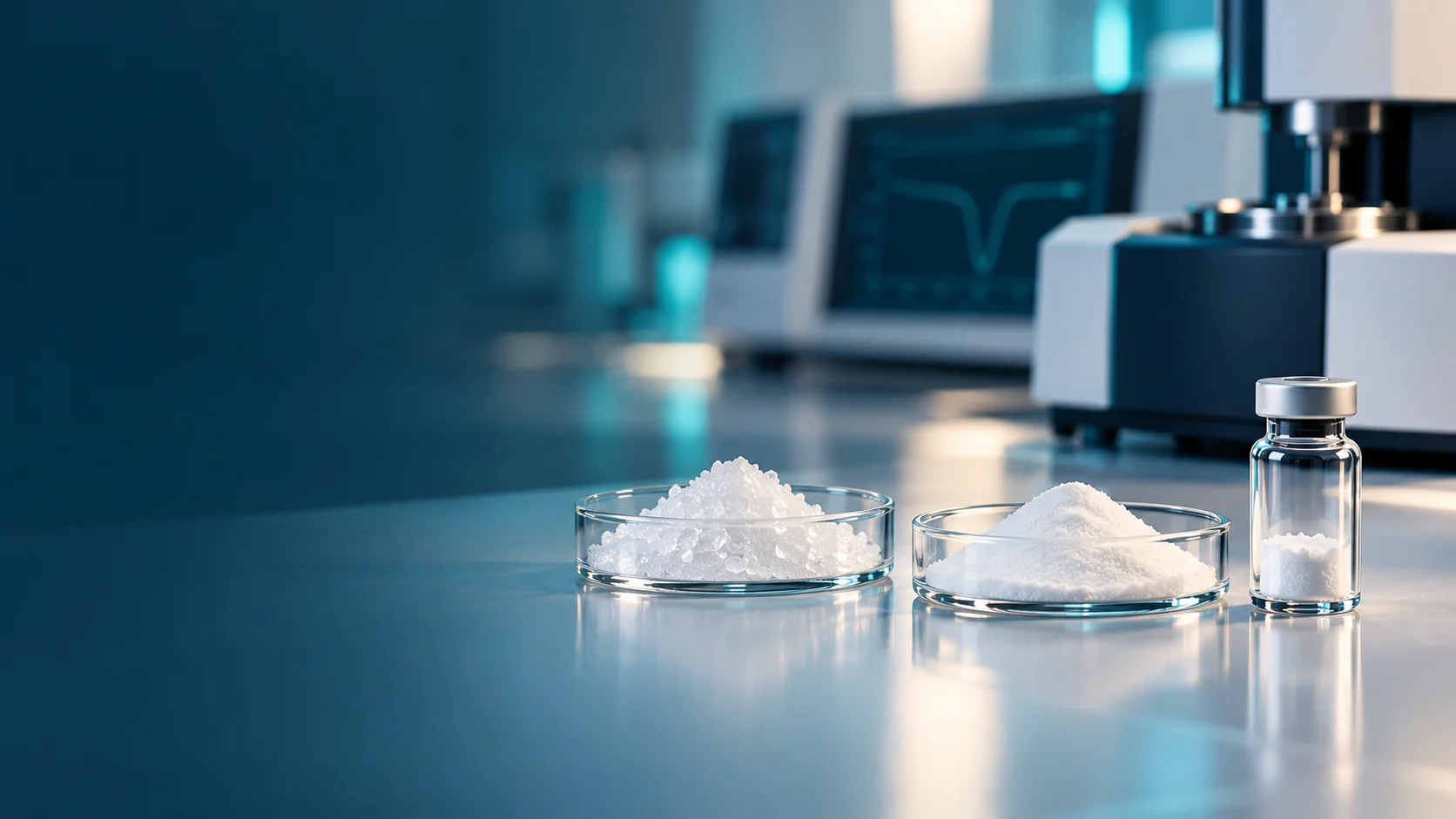
No excipient is automatically best for every lyophilized peptide powder. Sucrose or trehalose may form an amorphous matrix; mannitol may contribute cake bulk and can crystallize. The peptide sequence, salt form, concentration, buffer, desired cake, storage conditions and reconstitution liquid determine which combination is worth testing. Select on measured stability and manufacturability, not on an ingredient-name trend.
A bulk raw peptide and a filled cosmetic vial have different formulation questions. The raw powder may be supplied without an added bulking system, whereas a low-dose vial may need enough solid material to form a manageable cake. Before screening, record peptide identity and counterion, target peptide content per unit, fill volume, proposed activator, packaging and target market. Establish the risks that matter for this molecule: deamidation, oxidation, hydrolysis, aggregation, adsorption or a change in solution appearance, as applicable. A peptide with an asparagine residue, for example, should not inherit a stability claim from a different sequence. Define the analytical methods before interpreting a screening run. Existing counterion guidance and the identity checklist help lock the material definition.
Nonreducing sugars such as sucrose and trehalose are often screened for an amorphous protective matrix; mannitol is often screened as a bulking agent, but its crystalline state can change with the formulation and process. A buffer sets the solution environment before drying, yet pH measured at room temperature does not capture every shift during freezing. These are functions to test, not promises of a stable product. In an experimental study of two model peptides, sucrose and mannitol produced different solid-state deamidation behavior under the study’s specified elevated temperature and humidity. The result is useful evidence that solid matrix matters; it is not a universal ranking for commercial cosmetic peptides. An independent CSP7 peptide formulation study also found counterion retention varied with excipient and storage conditions.
| Candidate | Reason to screen | Question to verify |
|---|---|---|
| Sucrose or trehalose | Amorphous matrix formation | Peptide chemical stability, moisture sensitivity and cake behavior |
| Mannitol | Bulk and cake structure | Crystalline state, peptide compatibility and vial appearance |
| Buffer system | Controlled solution environment | Peptide stability and possible freeze-concentration effects |
| Combination | Balance of matrix and bulk | Whether the blend outperforms single candidates across the full test panel |
A useful comparison holds peptide lot, nominal fill and container constant while varying a small, justified set of excipient ratios or buffer conditions. Thermal analysis can help identify formulation-specific transition behavior; diffraction can distinguish crystalline from amorphous excipient states when relevant. After drying, record cake appearance, residual moisture, reconstitution time and peptide-related impurity profile. Then compare samples under a documented stability protocol in the intended package. Do not choose a formula solely because it makes a white, tidy cake: it may still underperform chemically or after reconstitution. The freeze-drying scale-up case studies show why freezing behavior and product resistance can change with production conditions, so promising bench results need transfer confirmation.
Once a formulation meets the agreed quality targets, fix its composition and calculation basis. Specify peptide and each excipient by controlled name and grade, the target and permitted range, mixing sequence, fill, closure, cycle version and test methods. Set acceptance criteria from development and stability evidence rather than inventing a generic peptide purity or moisture limit. If an activator is part of the kit, assess compatibility after mixing and its microbiological controls as a separate workstream. Document whether results belong to cosmetic, research or pharmaceutical development; evidence from one pathway does not confer another pathway’s authorization. For the broader project workflow, see formulation planning and multi-peptide blend development.
No. They can serve different roles, and the outcome depends on the peptide, ratio, physical state, cycle and storage conditions. Compare the actual formulations with stability-indicating methods.
Possibly. It depends on dose, solids content, cake handling, reconstitution and stability. Test the proposed presentation rather than assuming a bulking agent is mandatory.
No. Appearance is one attribute. Chemical degradation, water content and reconstituted performance require separate evidence over the intended storage period.
Editorial scope: formulation-screening principles for B2B peptide projects, not a ready-to-manufacture recipe or a claim of validated shelf life.