
INCI Name, CAS Number and Peptide Identity: What Cosmetic Buyers Should Verify
An INCI name, CAS number and batch identity test answer different questions. Learn what to compare before accepting a cosmetic lyophilized peptide powder.
An INCI name, CAS number and batch identity test answer different questions. Learn what to compare before accepting a cosmetic lyophilized peptide powder.
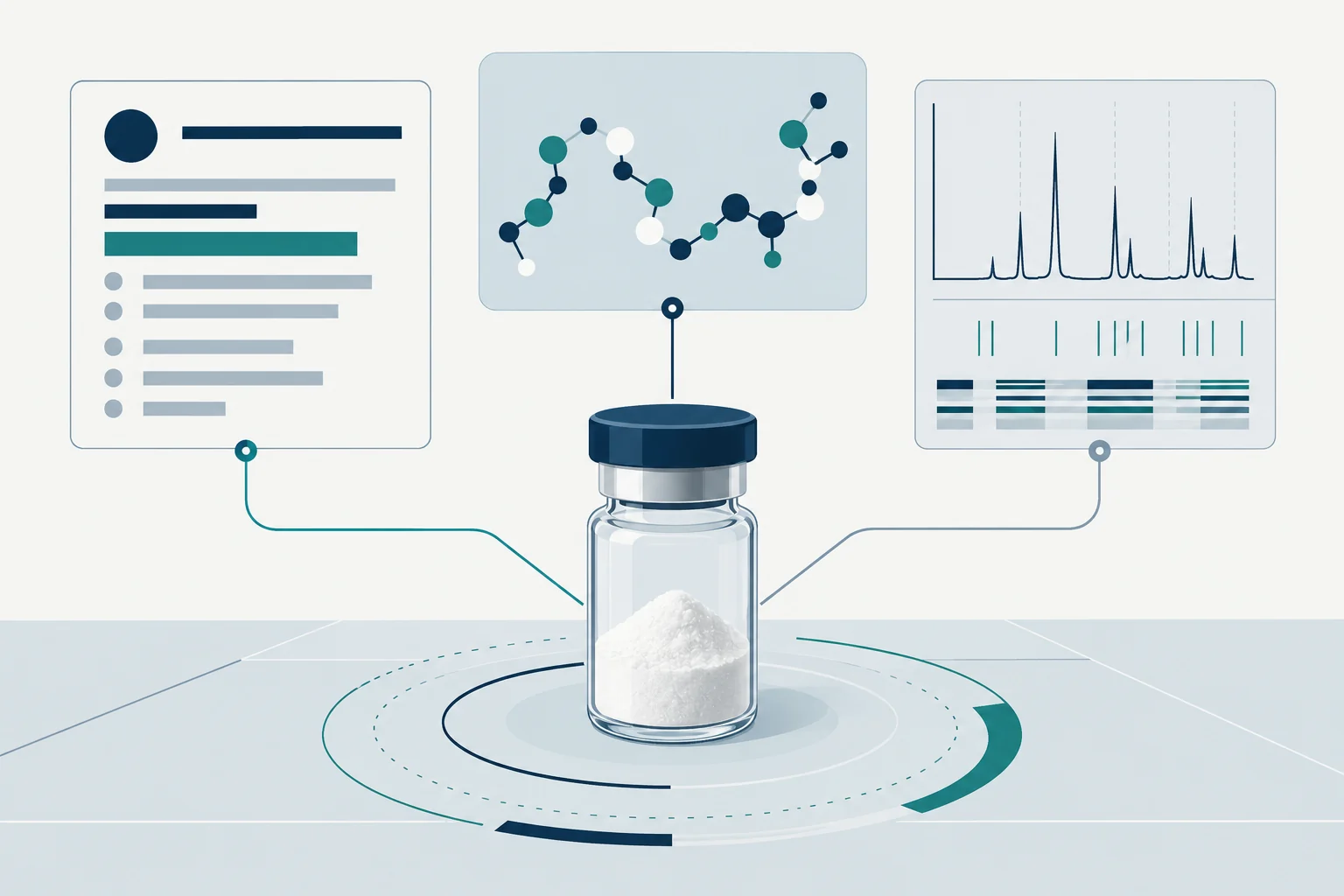
An INCI name helps identify an ingredient for cosmetic labeling. A CAS number may help locate a chemical record. Neither one, by itself, establishes the exact composition or quality of a lyophilized peptide powder offered for purchase. Compare the proposed material against a written identity specification and batch-specific analytical evidence before treating two offers as equivalent.
International Nomenclature of Cosmetic Ingredients names provide a common vocabulary for ingredient declarations. The European Commission’s CosIng database includes common ingredient names and related information; it can be searched using names and certain identifiers. Its own notice says the database is informative, has no legal value, and that a listed INCI name does not itself mean an ingredient is approved or suitable for use. The Personal Care Products Council likewise states that assignment of an INCI name implies no approval, safety finding or purity grade.
A label name does not tell a formulator the peptide’s exact sequence, the distribution of related substances, its counterion, retained water, excipients or the test methods used for a particular lot. Some commercial powders are mixtures rather than a single isolated peptide. The buyer therefore needs the actual composition of the supplied material, including non-peptide components that matter to formulation and labeling. Confirm the name against the destination market’s current rules rather than copying a supplier’s label text.
A CAS Registry Number is a useful search and cross-reference identifier when one has been assigned. It is not a certificate of identity for the contents of a vial. The same commercial conversation may involve a free peptide, a salt form, a formulated powder, or a blend. A number printed on a product page cannot resolve those differences without a matching chemical description and lot documentation. If a supplier lists several identifiers, ask which one applies to the actual material supplied.
| Record | Useful question | What it cannot prove alone |
|---|---|---|
| INCI or local ingredient name | Which name may be relevant to a cosmetic ingredient declaration? | Sequence, grade, purity, safety, or permission for a specific market |
| CAS number | Which chemical record is the supplier referencing? | That this batch matches the referenced substance or composition |
| Identity specification | What exact material, form and limits has the buyer approved? | That a particular lot passed every required test |
| Batch COA and supporting data | Which agreed tests were reported for this lot? | Finished-product safety, stability or market compliance |
Start with a controlled description rather than a marketing name. For a single peptide, this may include the intended sequence, relevant modifications, salt or counterion form, powder composition, grade, and agreed analytical methods. For a multi-peptide blend, request the identity and target amount or range for each component, plus the carrier or other ingredients. The requested detail depends on intended use and disclosure obligations; confidential information can be managed through a suitable quality agreement.
A single chromatographic retention time is rarely a complete identity argument for a complex peptide. Mass spectrometry or another suitable orthogonal technique can add information about molecular identity; the method must fit the sequence and intended decision. The EMA synthetic-peptide guideline describes analytical approaches for sequence confirmation and related quality attributes in its pharmaceutical scope. Those principles are useful questions for a buyer, but citing the guideline does not make a cosmetic raw material pharmaceutical grade.
Purity and content answer different questions. An HPLC main-peak area does not measure all powder mass. Salt, water and other components may affect the amount of peptide delivered per gram. Our purity versus content guide explains that distinction; the counterion guide covers salt-form questions. If two suppliers use different calculation bases, request aligned reporting before comparing price per unit of peptide.
In the EU, the Commission’s glossary supports common ingredient names for labeling under the Cosmetics Regulation, while the Regulation and its annexes determine the applicable legal conditions. In the United States, FDA explains that retail cosmetic ingredients are generally declared by common or usual names under 21 CFR 701.3; using an INCI term does not replace the applicable U.S. naming rule. Other destinations may differ. A current market review should cover the finished formulation, claims, presentation and label, not only the peptide powder.
Before artwork approval, ask the responsible regulatory reviewer to match the supplier’s composition disclosure to the actual ingredient declaration. If a vial kit includes a separate solvent or additional ingredients, review those components as well. Preserve the source version and review date so a later naming change or reformulation can be traced.
For each material code, keep one approved record linking its proposed ingredient name, chemical identifiers where relevant, technical description, supplier specification, analytical methods, sample lot and batch COA. Record open questions rather than filling gaps with an assumed synonym. A replacement supplier should be compared against this record, then assessed for any differences that affect formulation, quality or labeling. The supplier qualification guide describes how to scale that review to project risk.
No. CosIng and the Personal Care Products Council both state that nomenclature does not itself confer approval, safety or a purity grade. Suitability requires the applicable market and finished-product assessment.
No. It is a reference identifier. A buyer still needs a defined material description and suitable batch evidence showing what was supplied.
Yes. The powders can differ in composition, salt form, water, peptide content, excipients or quality controls. Compare controlled specifications and methods.
Align the composition disclosure, proposed naming, technical data sheet, approved specification and batch evidence, then review the finished label under destination-market rules.
This article addresses identity and naming decisions for cosmetic peptide procurement. Regulatory and analytical requirements must be set for the actual material, intended use and destination market. It reports no Hytanbio batch result.