
Lyophilized Peptide Cake Appearance: Collapse, Shrinkage and Cracks
How to distinguish freeze-dried peptide cake defects, connect visual observations to analytical evidence and write a product-specific appearance standard.
How to distinguish freeze-dried peptide cake defects, connect visual observations to analytical evidence and write a product-specific appearance standard.
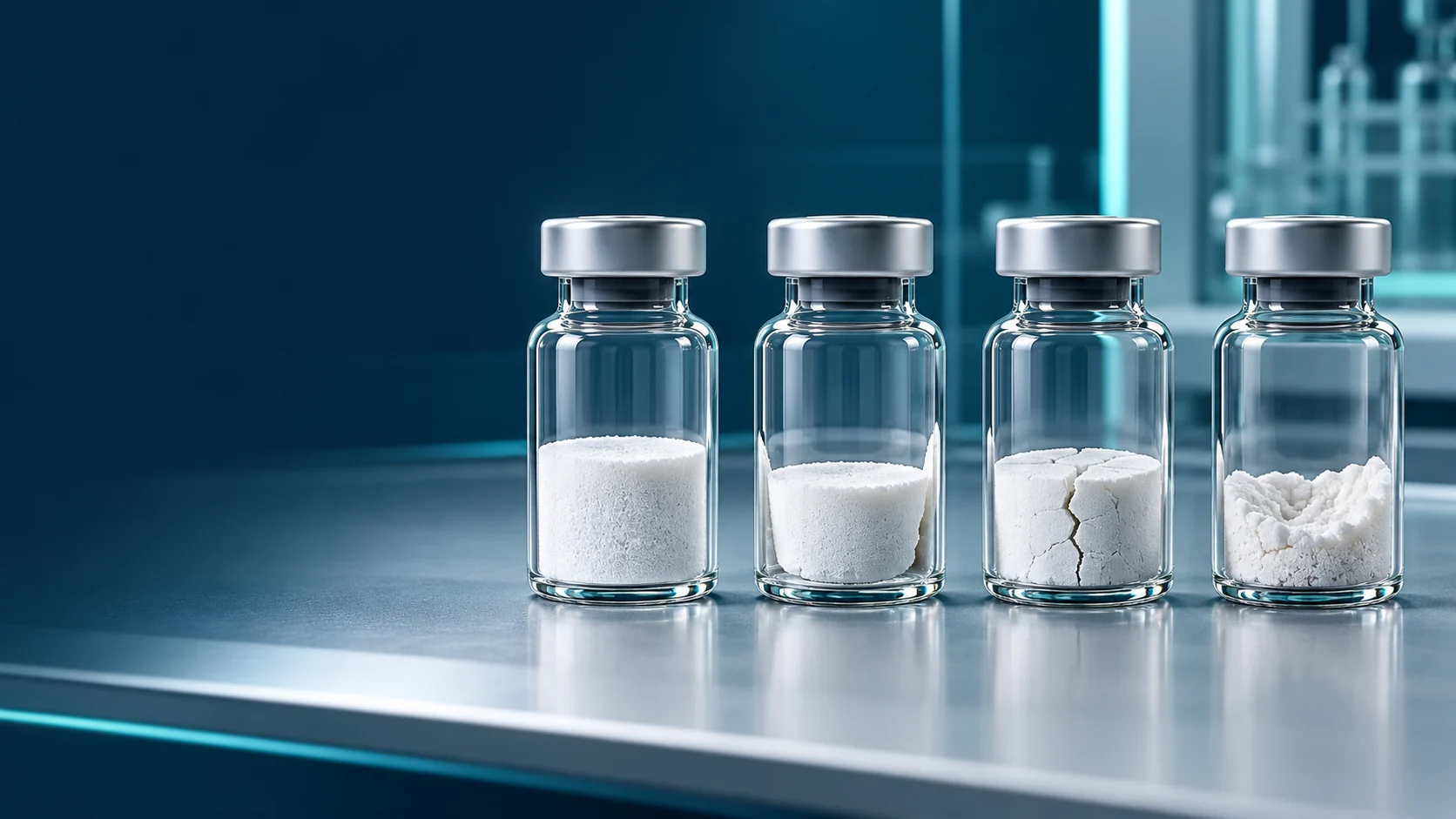
A lyophilized peptide cake should be assessed against a written, product-specific appearance standard, then checked against chemical and physical tests before a batch decision. A crack, a sunken surface and a shrunken cake are different observations; none establishes peptide purity or degradation on its own. The useful question is what changed in the formulation, freezing profile, drying cycle or container.
Freeze-drying leaves a porous solid where ice once occupied space. That structure can make a vial easy to inspect and reconstitute, but appearance is only one quality attribute. A published freeze-drying study scored collapse, shrinkage, cracks, surface skin, splashing and nonuniformity as separate defects; its material was a cell-secretome formulation, so those scores are not acceptance limits for a cosmetic peptide. Record the observed feature, its location and its frequency across the load. Compare representative edge and center vials and retain photographs under consistent lighting. A batch with a visibly intact cake still requires its specified identity, assay, impurity, moisture and reconstitution checks. Conversely, a cosmetic project should not automatically reject every harmless cosmetic imperfection without a justified specification and stability evidence.
Collapse is loss of the porous cake structure and may indicate that product temperature exceeded the formulation’s structural limit during primary drying. Shrinkage is a gap between cake and vial wall; it can arise from formulation and freezing behavior without proving the same mechanism as collapse. Cracks can appear during freezing or drying because of mechanical stress, but a crack alone does not identify a failed peptide. A surface skin or splashed material points the investigation toward fill preparation, loading or pressure behavior. These are working hypotheses, not diagnoses from a photograph. The AAPS PharmSciTech scale-up case studies show that changing equipment and freezing conditions can alter cake behavior even when nominal shelf set points are copied.
| Observation | Check first | Do not conclude from sight alone |
|---|---|---|
| Collapsed or melted-looking region | Product-temperature history, critical formulation temperature, pressure and drying endpoint | Exact peptide assay or microbiological status |
| Side-wall shrinkage | Solids content, excipient phase behavior, freezing profile | That the cake has necessarily failed its specification |
| Crack or split | Freezing stress, vial geometry and distribution in the load | That peptide identity has changed |
| Skin or splash | Fill, loading, pressure transitions and inspection criteria | A single universal root cause |
For a peptide vial, the investigation should compare affected and unaffected units from the same batch when sampling permits. Use a stability-indicating chromatographic method to look for changed impurity profiles, and a separate content or assay method where required; an HPLC area-percent result is not automatically peptide mass content. Karl Fischer or another validated water method addresses residual moisture. Time to complete dissolution, visible particles and solution appearance belong in the reconstitution test, with a defined liquid and observation conditions. Those measurements answer different questions, so a good-looking cake cannot replace them. The lyophilization process-verification recommendations discuss cake appearance, residual moisture and reconstitution time as distinct quality attributes in the pharmaceutical setting; cosmetic specifications must be justified for their own intended use.
Define representative photo standards and a vocabulary before production, not after a customer notices a defect. The standard can distinguish an acceptable minor cosmetic variation from collapse, foreign material, broken glass or other nonconformities that need quarantine. Tie each rule to the project’s formulation, container, test methods and stability history. Inspect multiple positions in pilot and commercial loads because heat transfer is not uniform across all vials. Keep the investigation traceable: change one relevant formulation or cycle variable at a time where practical, document the result, and update the visual standard only under change control. For related controls, see vial quality control, residual moisture and glass transition, and stability-indicating methods.
No. A crack is a physical observation. Compare the specified identity, assay, impurity profile, moisture and reconstitution results before drawing a chemical conclusion.
Only a product-specific quality assessment can decide. Collapse may affect water content, dissolution or stability even when one assay result passes; investigate against the approved specification and stability evidence.
No. The limit depends on formulation, vial geometry, intended use and the evidence supporting appearance and performance. Do not borrow a number from an unrelated product.
Editorial scope: a technical buyer guide for cosmetic peptide powder and vial projects. Drug, injectable and research-only products require their own specifications and regulatory pathway.